Skip to content

Writing about disability
An inclusive language guide for content and marketing teams
Why this matters
The words we choose shape how people are seen and treated. Inclusive language helps you communicate in a way that is accurate respectful and human, without making disability the “story” unless it’s relevant.
Core principles
1) Put the person first but don’t force one style
Different people prefer different language. Some prefer:
| Identity-first: | “disabled person” “Deaf person” “autistic person” |
| Person-first: | “person with a disability” “person with epilepsy” |
There isn’t one universal rule, but whenever you can, follow the individual’s preference.
2) Mention disability only when it’s relevant
- If disability isn’t important to the message don’t include it.
- Avoid describing someone as disabled as a default detail especially when it adds no meaning.
3) Avoid “medical” or “victim” framing
Steer away from language that:
- Treats people as patients
- Implies tragedy suffering or helplessness
- Suggests a person is defined by a condition
Aim for neutral factual descriptions.
4) Avoid euphemisms and “inspiration” framing
Terms like “handicapable” “differently abled” or “special needs” are often used to avoid saying “disabled”, and can feel patronising. In most cases use direct plain terms.
5) Be careful with metaphors and casual phrases
Many common sayings use disability as a negative metaphor (“blind to” “deaf to” “crazy”). These can normalise stigma. Choose alternatives that mean what you actually intend.
Quick choices: what to say instead
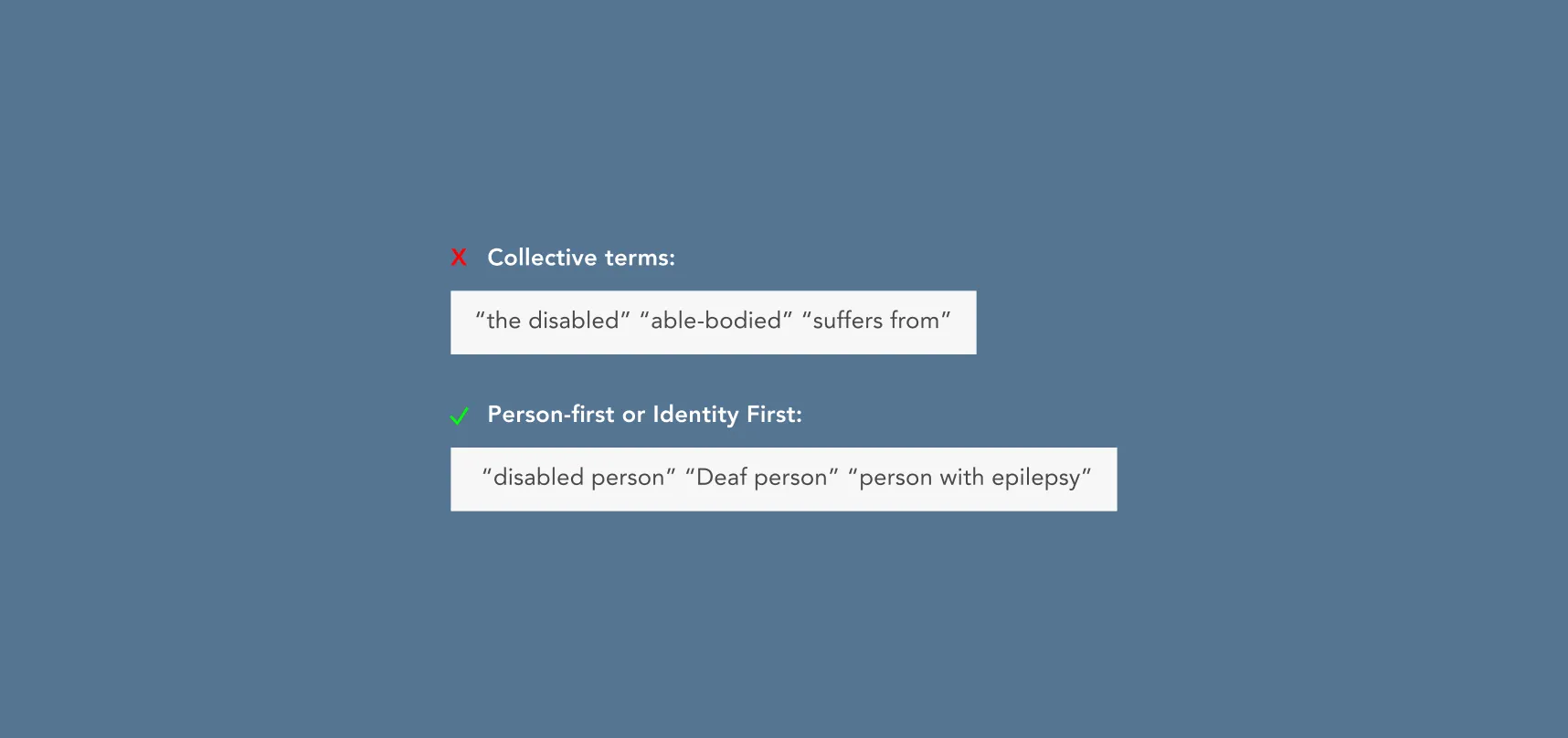
Collective terms
Avoid:
- “the disabled”
- “able-bodied”
Use instead:
- disabled people
- non-disabled people
Notes:
- Many people use “Deaf community” (often capital D) as a cultural identity.
- Some people who access support may prefer “people with health conditions or impairments” in certain contexts.
Condition language: keep it neutral
Avoid phrases that imply pity or suffering:
- “suffers from”
- “victim of”
- “afflicted by”
Use instead:
- “has [condition]”
- “is [disabled / Deaf / blind]” (if that’s the person’s preference)
- “uses [assistive tech]” (e.g. “uses a wheelchair” “uses a screen reader”)
Mobility and access needs
Avoid:
- “confined to a wheelchair”
- “wheelchair-bound”
Use instead:
- wheelchair user
- uses a wheelchair (a wheelchair is a tool for independence not confinement)
Disability terms to avoid (and safer alternatives)
Here’s a practical set you can include in an internal style guide.
Avoid outdated or offensive terms
Avoid:
- “handicapped”
- “cripple” “spastic” “midget”
- “insane” “mad” “psycho” “lunatic”
- “retarded” “mongoloid”
- “deaf and dumb” “deaf-mute”
- “the blind”
Use instead:
- disabled person / disabled people
- person with cerebral palsy (or preferred term)
- person with restricted growth / short stature (or preferred term)
- person with a mental health condition
- person with an intellectual disability / learning disability (regional usage varies)
- Deaf person / hard of hearing person / BSL user (when relevant)
- blind person / people with visual impairments / blind and partially sighted people
Avoid ableist metaphors and casual insults
Avoid:
- “blind to the facts”
- “turn a deaf ear”
- “crazy idea”
- “that’s lame”
- “are you insane?”
Use instead:
- “ignored the facts”
- “refused to listen”
- “unexpected / unrealistic / confusing”
- “unhelpful / weak / ineffective”
- “that doesn’t make sense”
Simple rule:
Say what you mean without using disability as shorthand for “bad”.
Describing severity or capability: proceed carefully
Labels like “high functioning” / “low functioning” can be reductive and are widely disliked.
Prefer:
- “needs support with…”
- “uses…”
- “has difficulty with…”
- “significant” rather than “severe” (when you need a qualifier)
Be specific about the context not a global judgement.
Behaviour tips for respectful communication
- Speak to disabled people the same way you speak to anyone else: adult to adult
- Don’t speak for someone or finish their sentences
- If someone has an interpreter or companion address the person directly
- If you’re unsure about language and you can ask ask
- Don’t freeze through fear of getting it wrong, aim to be respectful and adjust when corrected
A simple “decision checklist” for writers
Before publishing ask:
- Is disability relevant here?
- Am I describing the person in a neutral factual way?
- Have I avoided pity inspiration or medical framing?
- Have I avoided euphemisms and negative metaphors?
- If this is about a real person do we know their preferred language?